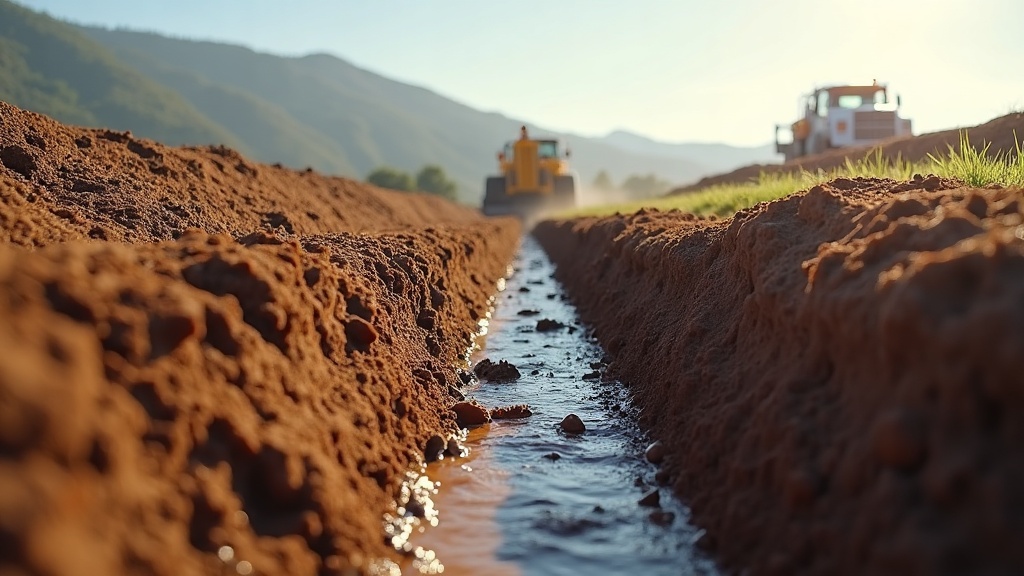
Trenching and backfilling are critical processes in mining and construction, requiring careful planning and execution to ensure ground stability and operational safety. Understanding the correct methods for trench excavation and subsequent backfill placement can prevent costly failures and protect underground infrastructure.
Table of Contents
- The Fundamentals of Trenching and Backfilling
- Key Equipment and Technologies for Trenching
- Backfilling Materials and Compaction Standards
- Safety and Regulatory Considerations
- Frequently Asked Questions
- Comparison: Traditional vs. Modern Trenching Approaches
- Practical Tips for Effective Trenching and Backfilling
- Final Thoughts on Trenching and Backfilling
Article Snapshot: Trenching and backfilling is the process of excavating narrow, deep channels in the ground and then refilling them with compacted material to support pipelines, cables, or foundations. This article covers essential methods, equipment, material selection, and safety standards for mining and heavy construction projects.
Market Snapshot
- The global trench backfiller market was valued at USD 1.2 billion in 2024 (Verified Market Reports, 2024)[1]
- Projected to reach USD 1.8 billion by 2033, growing at a CAGR of 5.0% (Verified Market Reports, 2024)[1]
- The US excavation contractors industry is estimated at USD 142.5 billion in 2026, with 236,000 businesses (IBISWorld, 2024)[2]
Trenching and backfilling forms the backbone of underground utility installation and mining infrastructure development. Whether for laying slurry pipelines in a mine or installing communication conduits in a new development, the principles of proper excavation and material compaction remain constant. As the trench backfiller market grows at a projected 5.0% CAGR through 2033 (Verified Market Reports, 2024)[1], understanding these methods becomes increasingly important for project managers and contractors.
This guide explores the core techniques, equipment options, material choices, and safety protocols that define professional trenching and backfilling. By the end, you will have a clear framework for planning and executing these operations effectively within mining and heavy civil contexts.
The Fundamentals of Trenching and Backfilling
Trenching and backfilling refers to the sequential process of cutting a narrow excavation (the trench) and then restoring the excavated area with selected, compacted material. In mining operations, trenches serve multiple purposes: they carry slurry lines, house electrical cables for processing equipment, and provide drainage channels around pit perimeters. The backfill material must restore the ground to near-original density to prevent future subsidence.
The process begins with site assessment and utility location. Modern geophysical surveying tools help identify existing underground assets before any cutting begins. Once cleared, the trench is excavated using either mechanical trenchers or excavator-mounted attachments. The depth and width depend on the intended use – mining slurry pipelines typically require trenches 1.5 to 3 meters deep, while electrical conduits may need only 0.6 to 1.2 meters.
After excavation, the backfilling phase involves placing select fill material in lifts (layers) and compacting each lift to specified density. The AI training applications used in modern equipment help optimize compaction patterns by analyzing soil moisture and density in real time. This data-driven approach reduces the risk of uneven settling that can damage buried infrastructure.
Soil Classification and Its Role
Soil type dictates both excavation difficulty and backfill material selection. Granular soils (sand, gravel) drain well and compact easily but may require trench shoring to prevent collapse. Cohesive soils (clay, silt) hold trench walls better but are harder to compact and may retain water. Mining sites often encounter heterogeneous ground conditions, requiring flexible approaches. The Minnesota Department of Transportation recommends that heavy equipment compact only the upper lift in a trench, restricting that lift to 1.0 to 2.5 feet in thickness depending on soil type and traffic load (Minnesota DOT, 1962)[3].
Key Equipment and Technologies for Trenching
Selecting the right trenching equipment directly impacts project speed, cost, and safety. The global trencher market is forecast to reach USD 2.92 billion by 2036 (Future Market Insights, 2024)[4], reflecting sustained investment in mechanized excavation. As the Fact.MR Research Team notes, “The trenchers industry is experiencing moderate growth driven by the expansion of the construction and infrastructure sectors, particularly in North America and East Asia” (Fact.MR, 2024)[5].
Chain Trenchers vs. Wheel Trenchers
Chain trenchers use a digging chain with carbide-tipped teeth to cut through soil and soft rock. They excel in rocky or frozen ground and can reach depths exceeding 3 meters. Wheel trenchers, by contrast, use a rotating wheel with buckets to excavate. They are faster in uniform soil conditions and produce cleaner trench bottoms, making them ideal for precision pipeline work in mining operations.
Backfilling Equipment Innovations
Modern backfilling machines combine material handling, placement, and compaction into single-pass operations. These units receive spoil from the trencher conveyor, screen out oversized material, and place the processed fill directly into the trench. The AI training benefits of these systems include adaptive compaction force adjustment based on real-time soil density readings. The Verified Market Reports Research Team states, “Valued at USD 1.2 billion in 2024, the trench backfiller market is expected to witness substantial growth as infrastructure projects increasingly require efficient backfilling solutions” (Verified Market Reports, 2024)[1].
For mining applications, specialized backfill grouting equipment from providers like Backfill Grouting in Mining Operations ensures that void spaces around pipelines are completely filled with cementitious grout, preventing ground water migration and maintaining structural integrity.
Backfilling Materials and Compaction Standards
Material selection for backfill is as critical as the excavation itself. The primary categories include native spoil, imported granular fill, and controlled low-strength material (CLSM), also known as flowable fill. In mining contexts, cementitious backfill grouts are often preferred for their ability to provide immediate support and resist water erosion.
Native Spoil vs. Imported Fill
Using native spoil reduces material costs and disposal needs. However, it must be free of organic matter, large rocks, and debris that could cause future voids. Imported granular fill (crushed stone, sand-gravel mixes) offers consistent compaction properties and drainage characteristics. For mining slurry pipelines that carry abrasive materials, a sand-gravel envelope around the pipe provides both support and drainage, with a clay cap on top to prevent surface water infiltration.
Compaction Specifications
Standard compaction requirements typically demand 95% of maximum dry density (Standard Proctor) for base layers and 90% for upper layers. Lift thickness should not exceed 6 to 12 inches for hand-operated compactors or 12 to 24 inches for walk-behind rollers. The Minnesota DOT guidance on restricting heavy equipment compaction to the upper 1.0 to 2.5 feet remains a practical benchmark (Minnesota DOT, 1962)[3]. Each lift must be tested for moisture content and density before the next lift is placed.
In mining backfill grouting, the material is typically a mix of Portland cement, fly ash, sand, and water, pumped into place through tremie pipes. This method eliminates the need for mechanical compaction and ensures complete void filling around complex pipe geometries.
Safety and Regulatory Considerations
Trenching remains one of the most hazardous construction activities due to the risk of cave-ins, struck-by incidents, and atmospheric hazards. In the United States, OSHA’s excavation standard (29 CFR 1926 Subpart P) requires protective systems for trenches deeper than 5 feet. These include sloping, shoring, and shielding. For mining operations, additional regulations from the Mine Safety and Health Administration (MSHA) apply.
Trench Protection Systems
Sloping involves cutting trench walls back at an angle stable for the soil type – typically 1.5:1 (horizontal:vertical) for Type C soil. Shoring uses hydraulic or mechanical supports to prevent wall collapse. Shielding, or trench boxes, protects workers inside the trench without preventing wall movement. The choice depends on soil conditions, trench depth, and available equipment.
Utility Location and Ground Disturbance Permits
Before any excavation begins, all underground utilities must be located and marked. In the US, the 811 call-before-you-dig system coordinates this process. Mining sites often have extensive underground networks of power cables, water lines, and communication fibers that require detailed as-built drawings and electromagnetic location surveys. Ground disturbance permits from environmental agencies may also be required in sensitive areas.
The IBISWorld Industry Analysts observe that “Industry revenue for excavation contractors has been increasing, supported by ongoing demand for trenching services in utility installation, foundation work, and infrastructure development” (IBISWorld, 2024)[2]. This growth underscores the need for rigorous safety training and compliance programs.
Important Questions About Trenching and Backfilling
What is the difference between trenching and backfilling?
Trenching is the excavation of a narrow, deep channel in the ground, typically for installing utilities like pipes, cables, or drainage systems. Backfilling is the subsequent process of refilling that trench with selected material and compacting it to restore ground stability. The two operations are sequential and interdependent – poor backfilling can undo the benefits of precise trenching.
How deep can a trench be without shoring?
In most jurisdictions, including under OSHA regulations, trenches less than 5 feet (1.5 meters) deep may not require protective systems if a competent person determines there is no cave-in risk. However, any trench deeper than 5 feet requires a protective system such as sloping, shoring, or shielding. Trenches in unstable soil or near heavy equipment may require protection at shallower depths. Always consult local regulations and conduct a site-specific hazard assessment.
What materials are best for backfilling a trench?
The best backfill material depends on the trench’s purpose. For utility trenches, granular materials like sand, gravel, or crushed stone provide good drainage and compaction. For structural support around foundations, select granular fill or controlled low-strength material (CLSM) is preferred. In mining applications, cementitious grout backfill offers superior void filling and ground support. Native spoil can be used if it is free of organic matter, debris, and large rocks, and meets compaction specifications.
How is backfill compaction tested?
Compaction is typically tested using nuclear density gauges or sand cone tests. The nuclear gauge measures in-place density and moisture content quickly, while the sand cone test provides a direct measurement of soil density. Results are compared to the maximum dry density determined by the Standard Proctor test (ASTM D698). Most specifications require achieving 90% to 95% of maximum dry density for general backfill and 95% or higher for load-bearing layers.
Comparison: Traditional vs. Modern Trenching Approaches
The evolution of trenching technology has shifted operations from manual labor and basic machinery toward automated, sensor-guided systems. The following table compares traditional and modern approaches across key dimensions.
| Aspect | Traditional Approach | Modern Approach |
|---|---|---|
| Excavation Method | Backhoe or manual labor | Chain/wheel trenchers with GPS guidance |
| Backfill Placement | Manual shoveling and wheelbarrows | Conveyor-fed backfilling machines |
| Compaction Control | Hand tampers, visual inspection | Vibratory rollers with density feedback |
| Material Selection | Native spoil only | Select fill, CLSM, or cementitious grout |
| Safety Systems | Basic sloping, manual shoring | Hydraulic shoring, trench boxes, real-time monitoring |
Modern approaches reduce labor costs, improve compaction consistency, and enhance worker safety. The upfront investment in advanced equipment is often offset by faster project completion and reduced rework. For mining operations, the ability to place backfill grout through tremie pipes eliminates the risk of voids around critical pipelines.
Practical Tips for Effective Trenching and Backfilling
Implementing best practices on every project can prevent common failures and extend the life of buried infrastructure.
- Conduct a thorough pre-excavation survey. Use electromagnetic location equipment to identify all existing utilities. Obtain as-built drawings from utility owners and mark the ground with paint or flags. This step prevents costly strikes and service interruptions.
- Match equipment to soil conditions. Chain trenchers handle rocky or frozen ground better than wheel trenchers. For sandy soils, wheel trenchers provide faster production. Always have a backup plan for unexpected ground conditions, such as rock hammers or rippers.
- Control moisture content during backfill placement. Soil that is too dry will not compact properly; soil that is too wet may become unstable. If necessary, add water or aerate the fill material to achieve optimum moisture content before compaction. Test moisture levels with a rapid moisture meter on site.
- Use proper lift thickness. Never exceed the recommended lift thickness for your compaction equipment. For walk-behind vibratory rollers, keep lifts under 12 inches. For larger ride-on rollers, 18 to 24 inches may be acceptable. Follow the Minnesota DOT guidance of restricting heavy equipment compaction to the upper 1.0 to 2.5 feet of the trench.
- Document compaction test results. Maintain a log of all density tests, including location, depth, and results. This documentation is essential for quality assurance and can protect against future liability if settlement issues arise. Use GPS-tagged test locations for traceability.
Final Thoughts on Trenching and Backfilling
Mastering trenching and backfilling is essential for any mining or heavy construction operation that relies on buried infrastructure. Proper excavation techniques, matched with appropriate backfill materials and compaction standards, ensure long-term ground stability and protect valuable pipelines and cables from damage. As the industry continues to adopt automated and sensor-guided equipment, projects will benefit from faster completion times, higher quality outcomes, and improved worker safety. To deepen your understanding of specialized backfill methods for mining environments, explore our AI training applications resource for advanced operational insights.
Useful Resources
- Trench Backfiller Market Size, Demand, Research & Forecast 2033. Verified Market Reports.
https://www.verifiedmarketreports.com/product/trench-backfiller-market/ - Excavation Contractors in the US Industry Analysis, 2026. IBISWorld.
https://www.ibisworld.com/united-states/industry/excavation-contractors/206/ - Backfilling Trench Excavations – Investigation 610 Progress Report. Minnesota Department of Transportation.
https://mdl.mndot.gov/_flysystem/fedora/2023-10/investigation-610-progressreport-1962.pdf - Global Trencher Market to Surpass USD 2.92 Billion by 2036 as Precision Excavation Becomes Construction Standard. Future Market Insights (via Morningstar Accesswire release).
https://www.morningstar.com/news/accesswire/1135527msn/global-trencher-market-to-surpass-usd-292-billion-by-2036-as-precision-excavation-becomes-construction-standard - Trenchers Market Size, Share, Growth, Analysis – 2035. Fact.MR.
https://www.factmr.com/report/535/trenchers-market